
24 May 22
Flower Power
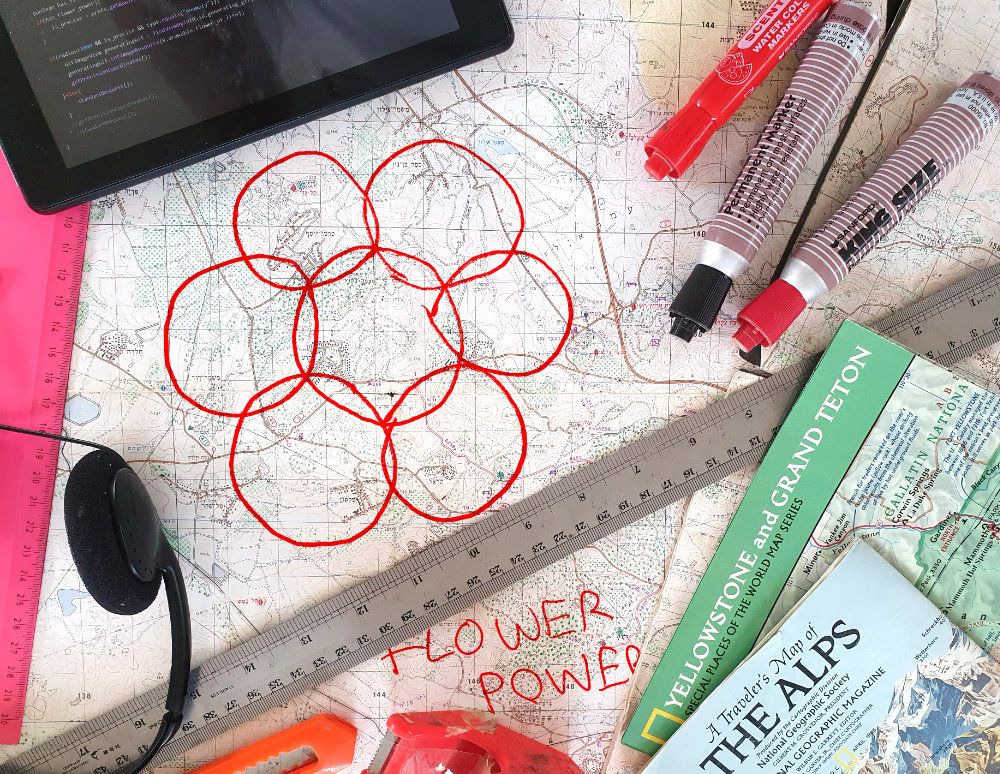
Update your App to the latest version (2.9 on Android, 9.0 on iOS) and check out the new "Flower Power" extension in the Shop. This new algorithm can be applied to all Attractor, Void, and Power Anomaly scans and has the potential to yield higher powered anomalies. We discovered this last year by coincidence while working on something else. Read the full story here:
At the heart of Randonautica lies the Fatum Project's proprietary anomaly calculation algorithm "libAttract". This is what detects attractors and voids in a given radius.
While working on the Extended Radius Add-on we released last year we were facing a technical limitation hard-coded into that algorithm. It consists of a maximum available radius of 29 kilometers (18 miles) for conducting the needed statistical calculations for finding anomalies. Above that radius the amount of needed randomness rises exponentially and calculations would become unbearably slow for the user and too expensive for us in computation power.
In order to find a workaround to this limitation we came up with the idea to split the overall desired radius up into smaller radii and run the calculations for each of these circles. One of the best geometrical shapes to cover as much area as possible with the smallest amounts of circles is an arrangement of six equal sized circles around a center circle with just minimal overlap.
We tested this arrangement of circles and scanned each of them for anomalies. The resulting anomalies were compared with each other and the strongest power anomaly selected as final result of the scan. Through many consecutive tests we found that the detected anomalies had often much higher power than running scans with similarly sized circles but without this geometric arrangement.
This was odd and we checked our code for errors and then also consulted with our Fatum Project research team about this phenomenon. They said that larger radii statistically show higher power anomalies than smaller ones, so from a mathematical point of view by dividing the large circle into seven small ones one would actually expect lower power results. Yet, the opposite was the case.
It seemed we had coincidentally found an anomaly in our calculating algorithm that would result in higher power anomaly detection. We are not sure whether this has something to do with using this specific arrangement of radius circles that resembles an outstretched version of the sacred geometry pattern commonly known as "Seed of Life" or "Flower of Life" or with the fact that we are pulling the needed random numbers in several chunks for each circle instead of once for the overall radius.
In any case we decided that this feature was too powerful to become a mere workaround for the technical limitation of the Fatum algorithm and should be made available as a standalone feature add-on for further experimentation and exploration of its potential.