
15 December 21
Blindspots
Written by d0ublezer0, inventor of the fatum project and the creator of the noveltism philosophy behind Randonautica
In a recent article named "Reality Tunnels" we talked about how we see the world around us not entirely, but only that part of it which the intricacies of our thinking and behavior patterns allow us to see, attracting similar things and events to us, and hiding everything else. Today we will try to go further in this thinking and look at the problem from a more mathematical angle.
To do this, let's refer to Chaos Theory. Chaos theory is a branch of mathematics that studies systems that, like our reality tunnel, operate according to certain rules, but behave unpredictably, since they are very sensitive to the slightest deviations in the initial conditions. This sensitivity is also called the Butterfly Effect or the Domino Effect, when some small and insignificant event creates a chain of consequences that lead to large changes.
It is because of such events that any artifact that has entered the reality tunnel from the outside can completely change its structure, as we have already described using the example of the Baader-Meinhof effect. So you learn something new and start to notice it everywhere, your behavior changes, you start to be interested in new things and this leads you to new places and situations. However, what is this "outside" behind the borders of the reality tunnel, and where are these borders?
In Chaos Theory, there is the concept of an attractor (not to be confused with attractor points in Randonautica, we will talk about them in other articles). An attractor is what the system gravitates to regardless of the initial conditions, for example, many different people can spend their day in completely different ways, but in the evening they all come home and go to bed, their different lives will come to a common event under the influence of biorhythms. To make it even clearer, consider a classic example called the Chaos Game.
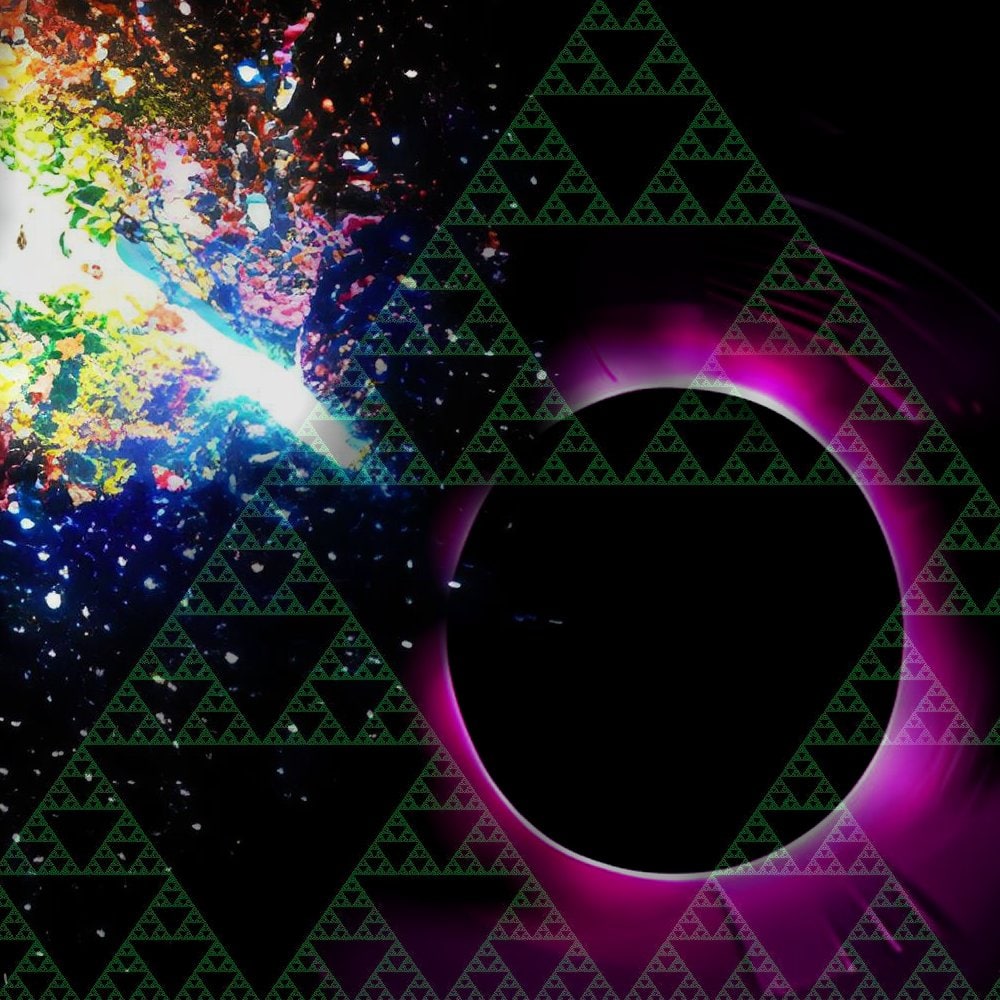
Its principle is as follows: first you need to select three random points on the plane surface. Then you need to put a fourth point between them at random. From this fourth point we start moving, but there is a rule: we can only move towards one of the first three points and only half the distance to it from the current point. Nevertheless, in the direction of which of the three points to move, we choose randomly, throwing a die, for example. When we have moved to a new point, we repeat the same thing from it. Our starting position and direction of movement are chosen randomly, but if we do this very many times, all the points that we draw will fold into a shape called the Sierpinski Triangle.
https://en.wikipedia.org/wiki/Sierpinski_triangle#Chaos_game
In this case, the Sierpinski triangle is the attractor, the pattern to which all the results of our random actions are attracted under the influence of a certain rule. It can also be called the space of probable outcomes, that is, even if we make only one random move in the Chaos game, we cannot know where exactly it will lead us, but we can be sure that it will lead us to one of the points lying on the Sierpinski triangle.
Much more interesting is that if you look at this triangle carefully, you can see areas in it where the points do not fall at all, for example, in its center. This is the place where the very rule of the Chaos game cannot lead with any combination of random parameters. In mathematics, this place is called a repeller, but we will call it the Blindspot. This analogy is all the more clear because in the case of blind spots of the eye, we also do not see part of the space, but we do not notice the gaps, since the brain fills the void on its own and the image seems to be continuous.
What does this have to do with our lives and the reality tunnels, you ask? Imagine a computer game, the plot of which depends on the decisions of the player. As a rule, such solutions provide only those choices that the game developer thought about, and in whatever combinations you choose them, they will lead you only to those endings that have been programmed. You can't get an ending that doesn't exist. The fact that we can choose different paths does not mean we can choose any path. As a rule, the very formulation of the choice already presupposes certain options, which means that such a decision tree will lead to a limited set of results.
In fact, all aspects of our life are governed by a huge number of different rules and patterns, some of which we apply consciously, some unconsciously, but even if it seems to us that we are acting in a random way, there is always a certain limited set of results that we can eventually achieve. And there are also places and events in which we simply cannot find ourselves, guided by the logic we are accustomed to, they are beyond our reality tunnel. The Stasis field, which holds us inside the reality tunnel, is also from a mathematical point of view a field of attractors that attracts us methodologically.
Again, I need to remind you that the Attractor Points in the Randonautica application have nothing to do with what we are talking about now. They are so called because of the peculiarities of the algorithm by which they are calculated and have nothing to do with the stasis field.
The only way to go beyond the Stasis Field is to learn how to temporarily "turn off" attractors, ceasing to be guided by patterns.
As a rule, it is very difficult to do this, since we will most likely also contradict the patterns still according to the rules of the pattern, by choosing opposite options, and filtering the results for those that seem interesting or convenient to us. So the only real way to disable patterns is to use a randomizer. The hardware random number generator chooses the result with equal probability, and therefore is not guided by any patterns other than the set of options from which it chooses.
To test this hypothesis, we chose the highest-resolution variation space: geographic coordinates. Here we are practically not limited by the set of options to choose from, since the map is continuous. In real life, the places we visit are unevenly distributed. The most powerful attractors are the routine paths we walk every day, such as the road between work and home. But even when we walk seemingly by chance, we still choose paths and places in a certain way, walk along the roads, build convenient routes, decide whether to go somewhere or not based on what we assume to see there. Therefore, it is obvious that Blindspots will also exist on the map of our environment - places that we cannot consciously get into at all, because none of our decision chains simply does not lead there. It's almost impossible to get to such places on your own, you simply won't find them. Somewhere in your yard there may be such a spot that you do not know about, and which you have never noticed, although you often walk by it.
These places don't have to be hard to reach or unpleasant, they can be completely ordinary places that we just never think of going to. But the fact that we never go there is also something intriguing, because everything that we have never seen can be there. It is logical that if we never see something, then it seems impossible to us, and this alone makes the imagination draw fantastic pictures of what may be in such places. Moreover, such blindspots can be found even in familiar areas. As you remember from the Sierpinski triangle, any even small area of it has holes in itself. By analogy, one can imagine that any place on the map will contain areas that we do not know about.
We can even fantasize and come up with a race of creatures that would live in a pattern-space completely opposite to ours, that is, they would walk next to us, but all the time they would be where we are not looking, and we would be where they are not looking either. But these are fantasies, and what about the reality? It is difficult to say exactly what percentage of the map area are blindspots, since the shape of the attractors is unique for each person.
To check this, you need to take a territory you know well and, using a random number generator, generate random coordinates on the map and visit them. Since such coordinates will have the same probability of pointing to any place on the map, then the probability of getting into the blindspot will not be zero. However, do not expect that the very first point will lead you to such a place, since the probability of getting to an ordinary, well-known place is also very high. Therefore, the experiment must be repeated many times. In practice, many Randonauts reported going to places they had never seen before. One Randonaut wrote that he had discovered an entire alley that he had never seen before within a five minute walk of his house. He was amazed at how he hadn’t noticed it before.
Such places are most often personal in nature, that is, they are blindspots only for the Randonaut himself, while for other people these spots can be a place for daily walks. The existence of blindspots that are hidden from all people in general is theoretically possible, but has not yet been proven. Finding them is one of the global tasks of Randonautica. After all, if millions of Randonauts visit random points all over the planet, the probability that at least one of them will find such a “higher rank” blind spot, which is invisible to everyone, will grow every day. And when they do, we all learn about it from user reports in the Discover feed. This means that even if you did not find any anomalies, the community will find them for you.
Therefore, do not be disappointed if there is nothing interesting in unfamiliar places. It is worth remembering that everything here has a probabilistic nature: the more points you visit, the more likely you are to find a blindspot, and the more blindspots you find, the more likely it is that they will contain something new for you. But even things that are not impressive at first glance but have novelty are capable of provoking unusual events in the future, changing the patterns of your behavior. Also, when exploring the phenomenon of blindspots, it is not necessary to limit yourself to points on the map. Any area of life where we make any decisions can be randomized, within reasonable limits, of course.
It is worth noting that the patterns limit our movement not only in space, but also in time. That is, in addition to the places that we never visit, there are also places that we do not visit at certain times of the day. There are many more places like this, but you will more likely find not things that are unusual in them, but events. For example, you will meet a neighbor there, whom you have not seen for 10 years, because you leave the house at different times. Thus, it is possible to expand the space of outcomes by walking to random coordinates at a random time. Of course, there are blindspots of a higher rank here, too, you don't even have to go far for an illustrative example - how many people will you meet in the forest at night in winter?
It should also be mentioned that we live in a world where everything is interconnected in one way or another, and the patterns of behavior of some people influence the patterns of behavior of others. All this gives rise to emergence: directly unrecognizable patterns of events that exist due to the interaction of many different patterns, like gears in a huge clockwork of fate. So you can never say with certainty how much your presence inside the blindspot will change the world and how soon these changes will manifest.
All this opens before us an endless scope for study, whether we will find new worlds outside our methodological environment, whether we will learn to control fate and make the impossible possible, it depends on you, curious researchers.